
Germany has solidified its position as one of the most attractive global destinations for international students, particularly those hailing from Kenya and the broader East African region
Table of Contents
- Introduction: Unlocking Your Future in Germany
- Understanding Admission Routes for Kenyan Students
- KCSE Graduates: The Studienkolleg Route
- Alternative Route: Direct Subject-Restricted Admission
- The Language Mandate: CEFR Levels and the Time Investment Trap
- Understanding the CEFR Standard
- German Language Requirements
- English Language Requirements
- The Time Investment Barrier
- Overview of the German Academic Calendar
- The Academic Semesters
- Application Windows
- Alignment with the Kenyan Calendar
- Winter Intake (October Start): High Reward, High Risk
- Advantages of the Winter Intake
- Challenges and Critical Risk Factors
- Ideal Profile for Winter Intake
- Summer Intake (April Start): The Strategic Buffer
- Advantages of the Summer Intake
- Challenges of the Summer Intake
- Ideal Profile for Summer Intake
- Strategic Intake Comparison and Scenario Analysis
- Scenario Guidance
- Ideal Preparation Timeline for Kenyan Students
- Strategic Financial Planning: The Blocked Account Requirement
- Common Mistakes to Avoid
- The Financial and Visa Timing Mismatch
- Ignoring the Academic Eligibility Pathway
- Failure to Secure Language Proof Early
- Document Certification and Translation Errors
- Conclusion and Final Recommendations
1. Introduction: Unlocking Your Future in Germany
The fundamental appeal lies in the offer of a world-class educational system combined with an accessible financial structure. Nearly all public universities in Germany charge no tuition fees for domestic and international students alike, significantly reducing the financial burden compared to many other study destinations.1 Students are only typically required to pay a small semester administrative fee, often ranging from €200 to €300, which covers essential services and frequently includes a subsidized public transport ticket known as the Semesterticket.
Beyond the academic savings, a German degree provides immense career value. Graduates gain access to Europe’s largest economy, where international talent is actively sought, especially in STEM fields. International students are permitted to work part-time up to 20 hours per week during semesters (or 140 full days per year) to gain experience and support living expenses.1 Critically, after graduation, students can secure an 18-month residence permit specifically for job searching, offering a clear pathway to securing a work visa or an EU Blue Card.
The critical factor determining a student's success in accessing this opportunity is not solely academic achievement, but meticulous timing. Applying to a German university is not a single submission event; rather, it is a multi-stage project spanning 9 to 12 months, encompassing document preparation, language proficiency testing, securing funds, and managing the visa process. This timeline revolves entirely around Germany’s dual intake system: the Winter intake (October start) and the Summer intake (April start). Understanding how these two intakes differ, particularly in relation to the Kenyan academic calendar and eligibility pathways, is the foundation of a successful application strategy.
2. Understanding Admission Routes for Kenyan Students
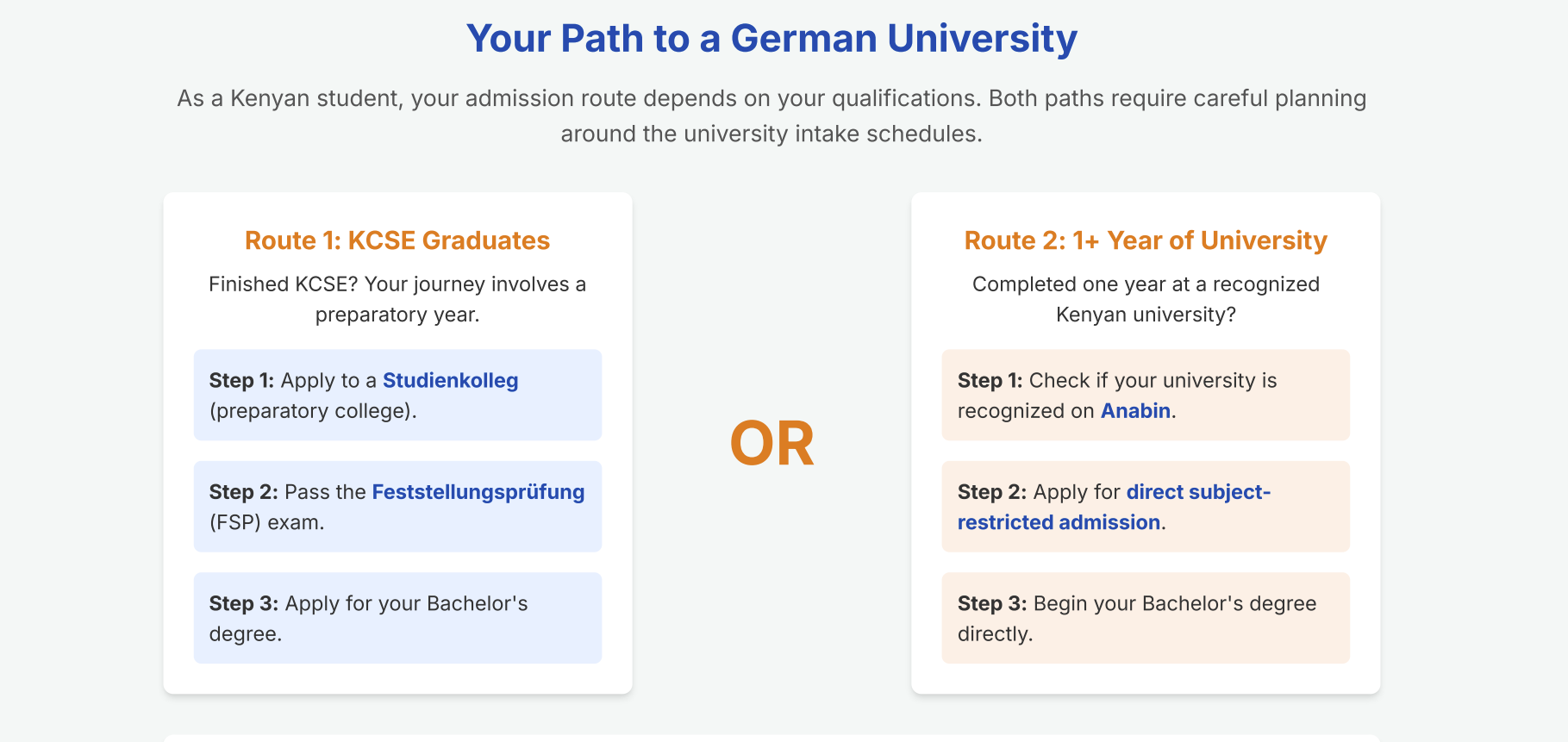
To study at a German university, applicants must possess the Hochschulzugangsberechtigung (HZB), an academic qualification deemed equivalent to the German high school leaving certificate, the Abitur.2 For Kenyan students, determining HZB status is paramount because the structure of the Kenya Certificate of Secondary Education (KCSE) typically places students into one of two distinct admission routes.
KCSE Graduates: The Studienkolleg Route
Kenyan students who hold the KCSE certificate alone, even with strong grades, usually fall into the category requiring mandatory preparatory education. The Kenyan secondary school system historically comprises 12 years of education, which is generally considered insufficient for direct entry into a German Bachelor's program.
For these students, the academic path involves compulsory attendance at a Studienkolleg (SK), a one-year preparatory college in Germany. A KCSE grade of C+ or higher typically qualifies the student only for entry into a Studienkolleg, not direct university admission. The Studienkolleg prepares students academically and culturally, culminating in the Feststellungsprüfung (FSP), or university qualification assessment exam. Successfully passing the FSP is what finally grants the HZB required for Bachelor’s degree enrollment.
Alternative Route: Direct Subject-Restricted Admission
A significant shortcut exists for Kenyan students seeking to bypass the one-year Studienkolleg. Students who have successfully completed at least one full academic year of study at a recognized university in Kenya may qualify for direct, subject-restricted admission to a German Bachelor’s program.
This pathway requires precise academic alignment: the German program the student applies for must be directly related to the discipline studied during their year in Kenya. However, the viability of this route hinges on external verification, making the process complex. The Kenyan university attended and the specific degree program must be verifiable in the Anabin database (Recognition and evaluation of foreign educational certificates). Institutions are classified using status ratings:
- H+ Status: The university is recognized in Germany, providing the best outcome.7
- H- Status: The degree is not recognized.
- H+/- Status: Recognition is decided on a case-by-case basis, requiring detailed evaluation.
If the student’s degree is classified as "entspricht Fachschule," it is unfortunately not recognized as comparable to a German university degree.7 Therefore, relying on this direct admission path without professional confirmation of the Kenyan university's H+ or suitable H+/- status in Anabin carries considerable risk. If verification fails, the student risks wasting a year of study in Kenya, only to find they must still proceed with the Studienkolleg route anyway.7 Comprehensive pre-application assessment is necessary to confirm eligibility and avoid such delays.
3. The Language Mandate: CEFR Levels and the Time Investment Trap

Language proficiency is frequently the most time-consuming and challenging prerequisite, often dictating how early a student must begin their preparation relative to the German university intake schedule. Whether applying for German-taught or English-taught programs, formal proof of language skill is non-negotiable.
Understanding the CEFR Standard
German universities utilize the Common European Framework of Reference for Languages (CEFR), a standardized scale spanning six levels (A1 to C2). A1 is a beginner level, while C2 represents mastery.
German Language Requirements
For Bachelor's and Master's programs taught in German, universities typically require C1 (Advanced) proficiency, usually proven through standardized examinations like the DSH-2 or TestDaF (minimum of 4 points in all four sections). Some Master's programs may accept B2 (Upper Intermediate) but often with the condition that the student must attend preparatory language classes after arrival.
Crucially, students taking the mandatory Studienkolleg route must demonstrate at least B1 (Intermediate) proficiency simply to sit for the entrance exam (Aufnahmetest) for public, German-taught SKs.Even a basic A1 certificate is often required when applying for a visa for preparatory language studies.
English Language Requirements
For the increasing number of English-taught programs, B2 or C1 proficiency is required. This is typically demonstrated via international tests such as IELTS Academic (5.5 to 6.5 for B2) or TOEFL iBT (72-94 for B2).While some universities may accept transcripts proving several years of English-only schooling, obtaining a formal test certificate is the most reliable way to secure both university admission and the subsequent student visa.
The Time Investment Barrier
The time required to achieve these mandatory CEFR levels is substantial and must be factored into the preparation timeline immediately. Waiting to start language instruction will automatically force a deferral to a later intake.
The table below quantifies the estimated cumulative instruction hours required to achieve key proficiency levels, assuming a dedicated student with prior exposure to language learning:
Table 1: Language Proficiency Requirements (CEFR) and Time Investment
CEFR Level | German Program Relevance | IELTS/TOEFL Equiv. | Estimated Cumulative Hours (Instruction) | Required Preparation Time (Full-time) |
A1 (Beginner) | SK Visa Minimum 12 | N/A | 60 – 150 hours 9 | 1-2 Months |
B1 (Intermediate) | Required for Public Studienkolleg Entrance Exam 3 | IELTS 4.5 10 | 350 – 490 hours 9 | 5-7 Months |
B2 (Upper Intermediate) | Minimum for some Master’s; Strong SK base 10 | IELTS 5.5–6.5 13 | 500 – 700 hours 9 | 8-10 Months |
C1 (Advanced) | Standard Requirement for most German Bachelor's/Master's 10 | N/A | 700 – 950 hours 9 | 12+ Months |
For a student aiming for a German-taught C1 degree, this requires commencing intensive language learning a full year before the university application deadline (July), not just before the semester starts in October. This language acquisition process thus becomes the single most time-critical component of the entire application strategy.
4. Overview of the German Academic Calendar
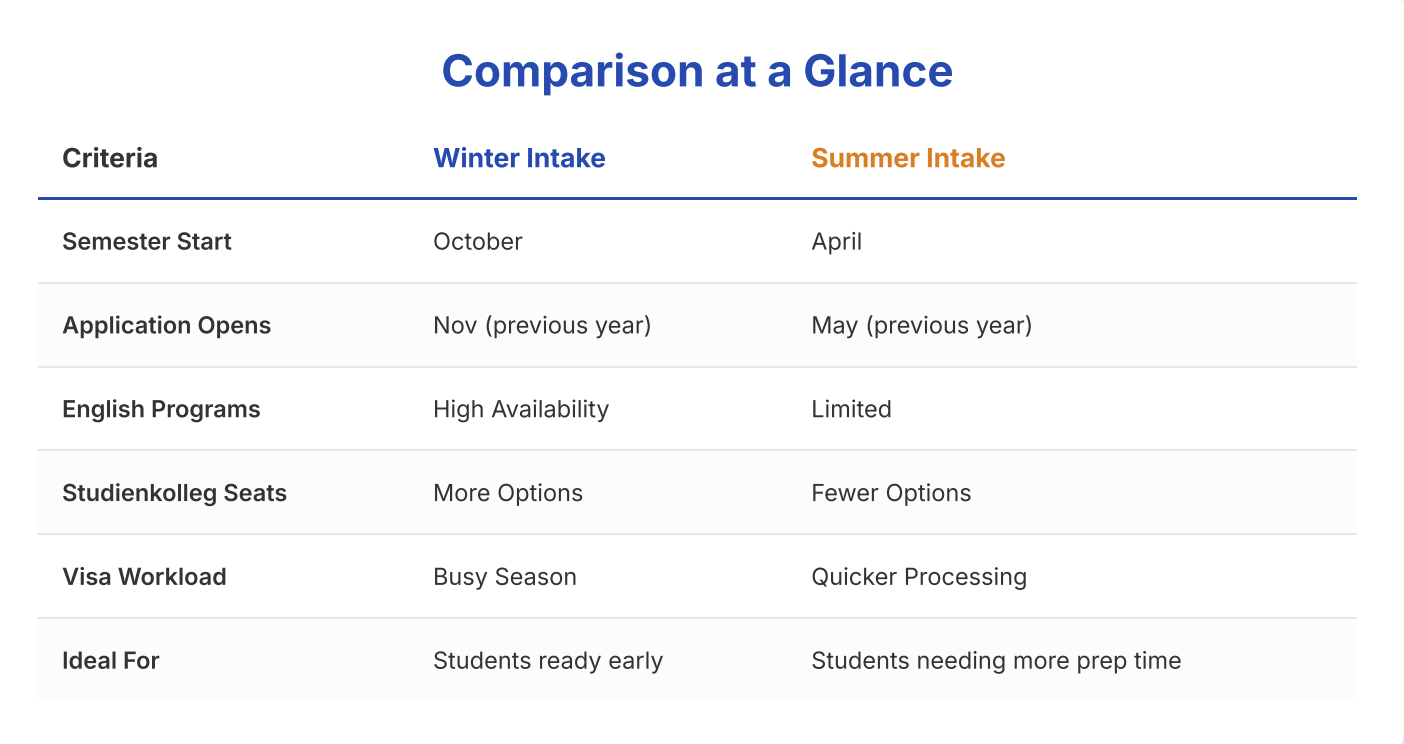
The German academic year is divided into two distinct semesters, each dictating a fixed application window and start date.
The Academic Semesters
- Winter Semester (Wintersemester): This is the primary and major intake. Lectures typically commence in October and run until March.
- Summer Semester (Sommersemester): This is the secondary and minor intake. Lectures typically commence in April and run until September.
Application Windows
The application periods are relatively consistent across public universities, creating tight windows for international applicants.
- Winter Intake Application Period: Applications generally open in mid-May and close rigidly on July 15th.16 Some non-restricted programs may offer later application deadlines until September 15th.
- Summer Intake Application Period: Applications generally open in December and close on January 15th.
Alignment with the Kenyan Calendar
KCSE exam results are typically released early in the year, often in January or February. This timing is favorable, allowing the student to confirm their qualification status and immediately begin intensive preparation in the first quarter of the year.
However, the key consideration is the time lag between the university application deadline and the visa approval. If an application closes on July 15th (Winter Intake), acceptance letters (Zulassungsbescheide) are sent out in August or September.18 This requires the student to secure a student visa appointment and receive approval before the October start date. Given that visa processing in Nairobi can take one to two months, and this period is the global peak travel season, an applicant submitting documentation near the July 15th deadline risks missing the October start due to bureaucratic congestion.19 A strategic applicant must aim to finalize their application by early June to ensure the Letter of Admission arrives in time to initiate the lengthy visa application process promptly in July.
5. Winter Intake (October Start): High Reward, High Risk

The Winter intake, starting in October, is regarded as the primary entry point into the German higher education system. It offers the greatest selection but demands the highest level of preparedness and logistical foresight from Kenyan students.
Advantages of the Winter Intake
- Maximized Program Selection: The vast majority of degree programs, including both German- and English-taught options across all disciplines (Engineering, IT, Business, Humanities), are offered starting in the Winter semester.2 This provides students aiming for specific fields with the broadest possible choice of location and institution.
- Enhanced Scholarship Opportunities: Most major scholarships and financial aid programs—including those offered by the German Academic Exchange Service (DAAD)—align their cycles with the Winter start. Deadlines for these opportunities often fall in the preceding autumn or winter, maximizing funding possibilities for students targeting the October entry.
- Optimal Studienkolleg Access: For students pursuing the Studienkolleg route, public SKs typically dedicate the majority of their capacity and course offerings (M-, T-, W- courses) to the Winter term. This translates to more options and higher overall acceptance rates for SK applications compared to the Summer intake.23
Challenges and Critical Risk Factors
The Winter intake's popularity is its own biggest obstacle for Kenyan applicants.
- Intense Competition: The larger applicant pool translates directly into higher competition, especially for courses with restricted admission (Numerus Clausus).15 Excellence in academic and language credentials is essential.
- Severe Visa Congestion Risk: This is the most critical logistical challenge. The window for visa application submission (August and September) coincides with the global peak travel and study migration season.21 Visa processing in Nairobi takes a minimum of one to two months, but this period is prone to significant delays and congestion at the German Embassy.19 A delay of just a few weeks can result in the student receiving their visa after the October lecture start, forcing a late arrival or deferral.
Ideal Profile for Winter Intake
The Winter intake is ideal for students who are highly ambitious, targeting specific, competitive courses, or seeking scholarship support. It is particularly suitable for KCSE graduates targeting the Studienkolleg path who have secured their B1 German certificate by April, or for KCSE + 1 Year Uni students who have achieved B2/C1 language proficiency by May. Success in this intake is defined by the student's ability to act early on all logistical requirements.
6. Summer Intake (April Start): The Strategic Buffer
The Summer intake is often referred to as the secondary intake. While it offers fewer academic options, it provides a crucial strategic buffer that can benefit students who require additional preparation time or a smoother logistical process.
Advantages of the Summer Intake
- Reduced Competition: The applicant pool for the Summer semester is significantly smaller than in the Winter semester. This means students face less competition for available programs, potentially increasing the chances of admission, especially in specialized Master’s courses.
- Smoother Visa Processing: The application period (December-January) and subsequent visa processing phase (January-March) fall outside the peak travel season congestion seen mid-year. This often results in faster and less stressful processing times at the German embassy in Nairobi.
- Time for Language Mastery: The gap between the July deadline of the previous Winter intake and the January deadline of the Summer intake provides a critical six-month buffer. This time can be invaluable for students who need additional time (e.g., October to January) to progress their German language skills from B1 or B2 to the mandatory C1 level, thus securing their application with the required proficiency certificate.
Challenges of the Summer Intake
- Limited Program Scope: The most significant drawback is the restricted course selection. Many popular Bachelor's programs, especially in German, and many foundational Master’s programs only admit students in the Winter semester.This severely limits the subject and location options available.
- Limited Scholarship Opportunities: Fewer DAAD and university-specific scholarships are aligned with the April start date compared to the October start, increasing the financial reliance on the student's own proof of funds (the blocked account).
- Scarcer Studienkolleg Seats: Studienkolleg spots are often more competitive and limited during the Summer term, sometimes requiring students to apply to multiple institutions to secure a place.
Ideal Profile for Summer Intake
The Summer intake is ideal for students who have missed the Winter deadline, those who require more time (e.g., 2-3 extra months) to achieve necessary B2/C1 language proficiency, or those who prioritize a less stressed application and visa timeline. It functions as a flexible pathway for strategic planning and mitigating external delays.
7. Strategic Intake Comparison and Scenario Analysis
Choosing the best intake requires a comprehensive assessment of the student's profile, qualifications, and logistical readiness. The ideal choice is not fixed but is dependent on the intersection of academic status and the speed of preparation.
Scenario Guidance
- KCSE Only (Studienkolleg Route): Students should strategically target the Winter intake because more SK seats are available, providing a higher chance of acceptance into the foundation program needed to qualify for a German university.Preparation must focus heavily on achieving B1 German proficiency by the SK application deadline (typically May-July).
- KCSE + 1 Year Uni (Direct Entry Route): Students following this route are academically prepared and should strongly target the Winter intake. This maximizes their choice of degree program, location, and access to funding.15 These students must aggressively manage the financial and visa steps to counteract the peak season risk.
Table 2: Winter vs. Summer Intake: Strategic Comparison for Kenyan Applicants
Criteria | Winter Intake (October Start) | Summer Intake (April Start) |
Intake Status | Primary/Major Intake 15 | Secondary/Minor Intake 15 |
University Application Window | Typically May 15 – July 15 16 | Typically December 1 – January 15 16 |
Program Availability (Breadth) | High (Most Bachelor’s & Master’s) 15 | Limited (Fewer Bachelor’s/Fewer English Master’s) 15 |
Studienkolleg Seat Availability | Generally Higher/Wider Selection 23 | Significantly Lower/Very Restricted 23 |
Competition Level | High Applicant Volume 15 | Lower Applicant Pool 26 |
Scholarship Opportunities | High (Major DAAD deadlines align) 15 | Limited 15 |
Visa Processing Risk (Nairobi) | High Congestion (July–September peak season) 21 | Lower Congestion (Smoother processing) |
Ideal For | KCSE+Uni students ready early; SK applicants prioritized for October start. | Students needing extra time for language certification; those who missed the Winter deadline. |
8. Ideal Preparation Timeline for Kenyan Students
A structured, 12-month preparation plan is essential to successfully navigate the deadlines, irrespective of the chosen intake. The timeline below focuses on the ambitious Winter intake (October start), as it requires the most intense logistical planning.
Strategic Financial Planning: The Blocked Account Requirement
A key component of this timeline is financial planning. To secure a German student visa, applicants must prove they have access to funds covering their living expenses for the first year, typically deposited in a mandatory blocked account (Sperrkonto). For 2025, the required minimum annual deposit is €11,904, equating to €992 per month.
For the Winter intake, the Confirmation of Blocked Funds is necessary to book the visa appointment, which should ideally happen in July. Since international fund transfers and confirmation can take between 1 and 5 business days, or sometimes up to two weeks, the funding process must be initiated well before the Letter of Admission is received.29 Proactively securing and confirming the blocked account funds in May or June is the only guaranteed way to mitigate the risk of late visa application during the peak summer congestion.
Table 3: Critical 12-Month Timeline for Winter Intake (Target October Start)
Timeframe (Relative to Start Date) | Action Items | Milestone Check |
12–9 Months Prior (Oct–Jan) | Confirm eligibility route (SK vs. Direct HZB) 5; Begin intensive German/English language studies (Targeting B1/B2) 30; Research programs and gather all academic transcripts 3; Initiate certification/translation of academic documents. | Language Course Enrolled; Academic Documents Certified |
8–6 Months Prior (Feb–Apr) | Finalize program list; Complete language exams (IELTS/B2 German) 13; Prepare motivation letters, CV, and letters of recommendation 3; For Direct Entry, check Kenyan university's status on Anabin.7 | Language Certificate Achieved (B2/C1) |
5–4 Months Prior (May–Jun) | CRITICAL FINANCIAL ACTION: Open and fund the Blocked Account (€11,904) 27; Begin submitting all final admission applications (aiming for submission before the July 15 deadline).16 | Blocking Confirmation Received; All Applications Submitted |
3 Months Prior (Jul) | Receive Letters of Admission (LOA); CRITICAL VISA ACTION: Book essential visa appointment immediately in Nairobi.25 | Admission Letter Secured; Visa Appointment Confirmed |
2–1 Month Prior (Aug–Sep) | Finalize German health insurance; Arrange accommodation; Attend pre-departure briefing; Await visa stamping (Processing time: 1–2 months).19 | Student Visa in Passport; Travel/Accommodation Booked |
Arrival (Oct) | Fly to Germany; Register with city authorities (Anmeldung); Enroll at the university.1 | Full Enrollment Completed |
9. Common Mistakes to Avoid
International student applications are frequently delayed or rejected due to easily avoidable administrative or logistical errors. Kenyan students must be aware of these common pitfalls.
The Financial and Visa Timing Mismatch
One of the most frequent errors is underestimating the time required for visa logistics.Students often wait until they have the university’s Letter of Admission (LOA) in hand—which can be late August for a Winter intake—before initiating the process of opening and funding the blocked account. Since the blocking confirmation is a mandatory document for the visa appointment, this delay pushes the crucial visa appointment booking into the busiest period (late August/September). This significantly increases the risk that the visa will not be processed before the October semester start.The critical measure to avoid this is to ensure the €11,904 blocked account is fully funded and confirmed by early July at the latest.
Ignoring the Academic Eligibility Pathway
Kenyan students sometimes mistakenly assume their strong KCSE results grant direct university entry, bypassing the Studienkolleg.Applying directly with only a KCSE certificate leads to automatic rejection because the academic qualification (HZB) is not met, resulting in a wasted application cycle and forcing the student to re-apply for a Studienkolleg place. Similarly, applicants relying on the "KCSE + 1 Year Uni" route must rigorously verify that their Kenyan university and degree are recognized via the Anabin database before applying, as subject-restricted direct admission depends on this validation.
Failure to Secure Language Proof Early
Language proof is not a flexible requirement; it must be met before the application is submitted. Waiting until the application period is underway to take the B1 (for SK) or C1 (for degree entry) exam is a high-risk strategy, given the substantial hours required to achieve proficiency. Applications are immediately rejected if the required CEFR certificate (B1, B2, or C1) is outdated or missing.31
Document Certification and Translation Errors
Submitting incomplete documents, using simple photocopies, or providing certificates and transcripts that have not been officially translated into German or English are major administrative mistakes. German universities require certified copies and notarized translations. Since Kenyan applicants, unlike those from countries such as India or China, are not currently required to obtain an APS certificate (Academic Evaluation Centre) to verify documents, the responsibility for flawless document preparation rests entirely with the student.32 Incorrect or uncertified submissions will lead to major processing delays or outright rejection.3
10. Conclusion and Final Recommendations
Both the Winter and Summer intakes provide viable, tuition-free opportunities for Kenyan students to pursue world-class education in Germany. However, the decision of which intake is best is entirely dependent on the student’s level of readiness, rather than a calendar date preference.
The Winter intake offers unparalleled choice and scholarship opportunities, making it the highest reward option. Yet, its success is defined by a ruthless logistical schedule requiring language certification and blocked account funding to be finalized months before the actual application deadline to counteract visa congestion risk.
The Summer intake provides a strategic alternative, mitigating the risk of mid-year visa delays and offering critical time for students who require extra months to achieve necessary language mastery. The trade-off is a severely limited selection of programs.
For any Kenyan student planning this academic journey, the recommendation is clear: start planning immediately. Do not wait for KCSE results or application portals to open. The absolute first step is to definitively confirm your academic eligibility route (Studienkolleg required vs. Direct HZB) and commence intensive language instruction aimed at securing the necessary CEFR certificate months ahead of the target intake deadline. Aligning your academic path with the correct German intake through early, strategic preparation is the key to unlocking your future in Germany.
Works cited
- COSMA Internal Guide.
- COSMA Internal Guide v2.
- Eligibility & Certificates Blog Posts
- Database on admission requirements - DAAD, accessed November 13, 2025, https://www.daad.de/en/studying-in-germany/requirements/admission-database/?ad-layer=5&ad-layerId=187
- Decision tree COSMA evaluation app
- anabin |
- Find out if your degree is recognized in Germany - the ultimate guide to Anabin, accessed November 13, 2025, https://hallogermany.com/blog/anabin-guide-academic-degrees
- German Language Requirements for International Students to Study in Germany, accessed November 13, 2025, https://www.mygermanuniversity.com/articles/language-requirements-german
- Common European Framework of Reference for Languages - Wikipedia, accessed November 13, 2025, https://en.wikipedia.org/wiki/Common_European_Framework_of_Reference_for_Languages
- Proof of Language Proficiency - Studying-in-Germany.org, accessed November 13, 2025, https://www.studying-in-germany.org/proof-of-language-proficiency-german-english/
- Language requirements for international students - Heidelberg University, accessed November 13, 2025, https://www.uni-heidelberg.de/en/study/advisory-services/learning-languages/language-requirements-for-international-students
- requirements for admission - Studienkolleg Germany, accessed November 13, 2025, https://studienkolleg-germany.com/requirement
- Language requirements (German/English) – Universität der Künste Berlin, accessed November 13, 2025, https://www.udk-berlin.de/en/application/language-certificate/
- Application process - DAAD, accessed November 13, 2025, https://www.daad.de/en/studying-in-germany/requirements/application-process/
- accessed November 13, 2025, https://www.mygermanuniversity.com/articles/Student-Visa-Germany-From-Kenya#:~:text=How%20long%20does%20it%20take,in%20Nairobi%2C%20not%20the%20TLScontact.
- Visa for higher education studies - Federal Foreign Office - German Embassy Nairobi, accessed November 13, 2025, https://nairobi.diplo.de/ke-en/service/visa-entry/2629250-2629250
- Application for Studienkolleg - The Complete Guide, accessed November 13, 2025, https://www.studienkolleg.org/en/application/